
EMGS Team
17th jul, 2026
0 reads
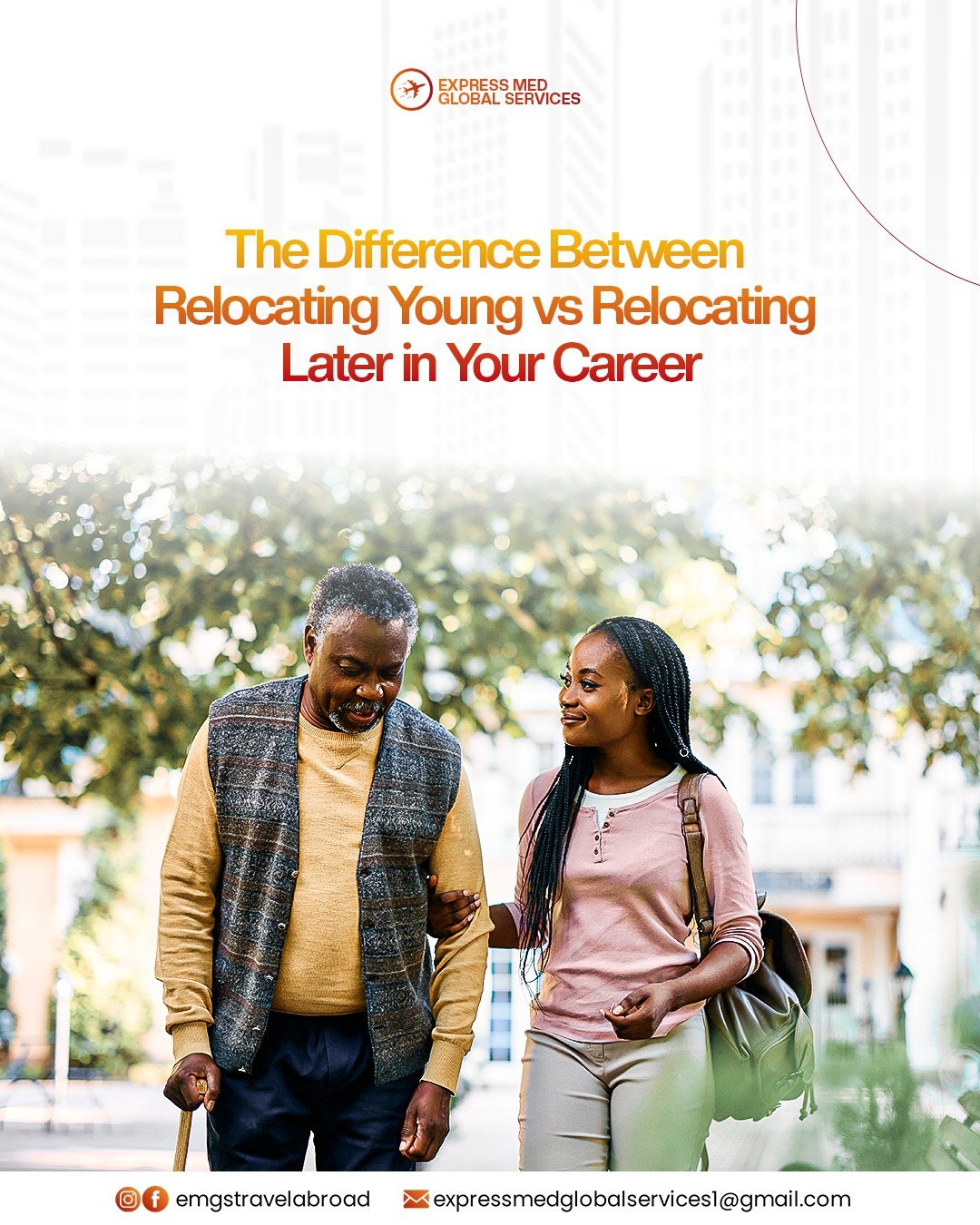
The Difference Between Relocating Young vs Relocating Later in Your Career
There is no perfect age to relocate abroad, but the experience of doing so changes depending on where you are in your career and life. Younger healthcare workers often have greater flexibility to explore different opportunities, while more experienced professionals bring valuable clinical expertise and clearer long-term priorities. This article examines how age influences the migration journey, the unique advantages and challenges at different career stages, and why thoughtful preparation matters far more than relocating according to someone else's timeline.
Spend enough time around African healthcare workers planning to relocate, and you'll notice a question that comes up repeatedly.
"Am I too late?"
It's usually asked by someone in their late thirties or forties who wonders if they should have made the move years earlier.
Then, almost in the same conversation, you'll meet someone in their twenties asking a completely different question.
"Should I gain more experience before relocating?"
It's an interesting contrast.
One person worries they've waited too long.
The other worries they're moving too soon.
Both assume there's a perfect age to relocate.
The truth is far more reassuring.
There isn't.
What changes isn't whether relocation is possible.
What changes is the experience of relocating.
Moving abroad at 25 and moving abroad at 45 can both lead to successful careers, but the opportunities, sacrifices, and adjustments often look very different.
Understanding those differences helps you prepare for the journey you're actually taking, rather than comparing it to someone else's.
Relocating young often means growing up in a new system
Healthcare workers who relocate early in their careers usually have one major advantage.
Adaptability.
They're often still developing professionally, which makes it easier to learn new clinical systems, adopt different workplace cultures, and adjust to unfamiliar ways of practising healthcare.
They're also more likely to have fewer financial responsibilities.
Some are single.
Others don't yet have children.
Many haven't accumulated major financial commitments.
This flexibility allows them to take risks they might hesitate to take later.
They may move between hospitals.
Pursue additional qualifications.
Change specialties.
Relocate to different cities.
Explore career opportunities that require starting from the beginning.
In many ways, they build their professional identity inside the healthcare system they've moved into.
But relocating early comes with its own challenges
Youth doesn't remove difficulty.
It simply changes its shape.
Healthcare workers who relocate earlier often have smaller professional networks.
Less clinical confidence.
Fewer years of experience.
They may spend more time proving themselves.
Learning not only how the healthcare system works, but also who they want to become within it.
Financially, the early years can also feel slower.
Building savings.
Establishing credit.
Developing specialist expertise.
Everything takes time.
The advantage is that they often have more years ahead to benefit from those investments.
Relocating later often means bringing valuable experience
Healthcare workers who move abroad after spending many years practising in Africa often arrive with something incredibly valuable.
Experience.
They've managed complex patients.
Led teams.
Mentored junior colleagues.
Handled challenging situations.
Developed strong clinical judgement.
These skills don't disappear simply because they relocate.
In many workplaces, experienced professionals quickly earn the respect of colleagues because they bring maturity, resilience, and confidence developed over many years.
They're often comfortable making decisions under pressure.
Communicating with patients.
Supporting multidisciplinary teams.
Those qualities are difficult to teach.
Yet experience doesn't always translate immediately
One of the hardest adjustments for some experienced professionals is realising that relocating may involve starting lower than expected.
Different countries have different licensing requirements.
Different scopes of practice.
Different healthcare systems.
An experienced nurse may still need to complete adaptation programmes.
A doctor may need additional examinations before practising independently.
A pharmacist may have to satisfy local registration requirements despite years of professional experience.
Emotionally, this can be difficult.
Not because their expertise lacks value.
But because proving it again requires humility and patience.
Understanding this reality beforehand makes the transition much easier.
Family responsibilities change the migration experience
Age often brings additional responsibilities.
Many healthcare workers relocating later in life are making decisions not just for themselves, but for spouses, children, or ageing parents.
Schooling becomes a consideration.
Housing requirements become different.
Financial planning becomes more complex.
Supporting relatives back home may remain an ongoing responsibility while also building a life abroad.
Every migration decision carries wider consequences.
This doesn't make relocation impossible.
It simply means planning becomes even more important.
The migration journey extends beyond individual ambition to include the wellbeing of an entire family.
Younger migrants often have more room to experiment
Career flexibility tends to look different earlier in life.
Someone relocating in their twenties may feel comfortable changing specialties after a few years.
Returning to university.
Exploring healthcare technology.
Trying public health.
Moving into research.
Changing employers several times while discovering where they fit best.
Time often creates freedom to experiment.
There is less pressure to have every answer immediately.
For many younger migrants, the first decade abroad becomes a period of exploration as much as professional growth.
Older migrants often make more intentional decisions
Healthcare workers who relocate later frequently approach opportunities differently.
They're usually less interested in chasing every possibility.
Instead, they ask practical questions.
Will this employer support my long-term goals?
Can my family settle comfortably here?
What pathway exists to permanent residency?
Does this role align with the life I want over the next fifteen years?
Experience often brings clarity.
Many older migrants make fewer career moves, but they tend to make those moves with greater purpose.
They're not necessarily moving faster.
They're often moving more intentionally.
Success cannot be measured by age alone
One mistake people make is assuming younger migrants automatically have an advantage.
Or that relocating later means you've missed your opportunity.
Neither is true.
Someone who relocates at 26 may still struggle with loneliness, career uncertainty, or financial pressure.
Someone who relocates at 48 may build an outstanding career because their experience makes them exceptionally valuable.
Migration isn't a race against age.
It's a process of preparation, adaptation, and persistence.
Your age influences the journey.
It doesn't determine the outcome.
Focus on timing that fits your life—not someone else's
Social media has made it easy to compare migration timelines.
Someone passes their licensing exams at 24.
Another buys a home at 30.
Someone else becomes a consultant at 40.
These stories can create the illusion that there's an ideal schedule everyone should follow.
Real life rarely works that way.
People relocate after military service.
After raising children.
After caring for ageing parents.
After changing careers.
After saving enough money.
After completing specialist training.
Every journey begins from a different place.
The important question isn't whether your timing matches someone else's.
It's whether you're preparing well for your own.
The best time is when preparation meets opportunity
Looking back, many successful healthcare workers abroad rarely say their age determined their success.
Instead, they talk about preparation.
Researching the right country.
Understanding licensing requirements.
Building clinical competence.
Strengthening language skills.
Planning financially.
Seeking trusted guidance.
Those factors matter far more than whether you relocate at 28 or 48.
Because migration isn't simply about arriving in another country.
It's about creating a sustainable career and a meaningful life once you get there.
Whether you relocate early or later, the challenges will be different.
So will the advantages.
What remains the same is the opportunity.
To grow professionally.
To create financial stability.
To expand your horizons.
And to build a future that reflects your goals—not the timeline someone else believes you should have followed.
In the end, successful migration isn't defined by your age when you boarded the plane.
It's defined by what you choose to build after you land.
Contact Us, click on this link https://selar.co/m/Express_Global to purchase any of our services or visit our website https://emgs.global/ — we're just a click away.
For CV, Supporting Statement, and Cover Letter: Chat this customer care number: +234 905 672
3938
Enjoyed this post? Like & share the knowledge!
Similar Reads

The Reality of Moving Abroad: Does Relocation Mean Starting Over?
EMGS Team
23rd jul, 2026
One of the biggest fears people have about moving abroad isn't about visas alone. It is the fear of losing everything they have spent years building. The career. The reputation. The professional network. The confidence that comes from knowing how things work. Many prospective migrants ask the same question: "Will I have to start all over again?" The honest answer is more complicated than a simple yes or no. For some people, relocation feels like pressing the reset button. They arrive in a new country and discover that employers expect local experience, professional licensing may be required, and the network they spent years building no longer exists. At the same time, they are not truly starting from zero. Their education, work experience and technical skills still matter. Their discipline, and professional maturity do not disappear simply because they crossed a border. Understanding what actually changes after relocation and what does not, can help migrants prepare more realistically and make better long-term decisions.
Sponsored Jobs Abroad: Are Doctors and Nurses the Only Professionals Wanted?
EMGS Team
22nd jul, 2026
Spend just a few minutes searching for visa-sponsored jobs abroad and you could easily reach the wrong conclusion. Doctors. Nurses. Care workers ... Scroll a little longer and it can begin to feel as though every employer willing to sponsor an international worker is recruiting from the healthcare sector. If you're an engineer, accountant, software developer, electrician, chef, teacher, or construction professional, you may start wondering whether you've chosen the wrong career for migration. The good news is that you probably haven't. Healthcare receives much of the attention because it has one of the world's most visible labour shortages. However, it is far from the only sector where employers recruit internationally. The real question is not whether sponsored jobs exist outside healthcare. The real question is whether your skills solve a problem that another country's labour market is trying to address. Understanding that difference can completely change the way you approach your migration journey.
Moving Abroad Without a Job Offer: Which Countries Allow Skilled Workers to Apply?
EMGS Team
22nd jul, 2026
If you've been waiting for a job offer before taking your migration plans seriously, you may be waiting longer than necessary. Many skilled professionals believe international migration follows only one formula: get hired first, receive sponsorship, then relocate. That assumption is understandable because many of the world's best-known work visa programmes are employer sponsored. Spend enough time searching job boards, reading migration forums, or scrolling through social media, and it can begin to feel as though no employer means no opportunity. Several countries operate skilled migration pathways that allow eligible applicants to begin their immigration journey without first securing employment. Rather than asking, "Who has hired you?" , these programmes ask different questions. What qualifications do you have? How much skilled work experience have you gained? Can you communicate effectively in the country's language? Will your skills contribute to the economy over the long term? This does not mean you can arrive without a plan or expect employment to happen automatically. It simply means that for some skilled workers, migration can begin before the first employment contract is signed. Understanding how these pathways work can help you choose a strategy that matches your qualifications instead of assuming employer sponsorship is your only option.